
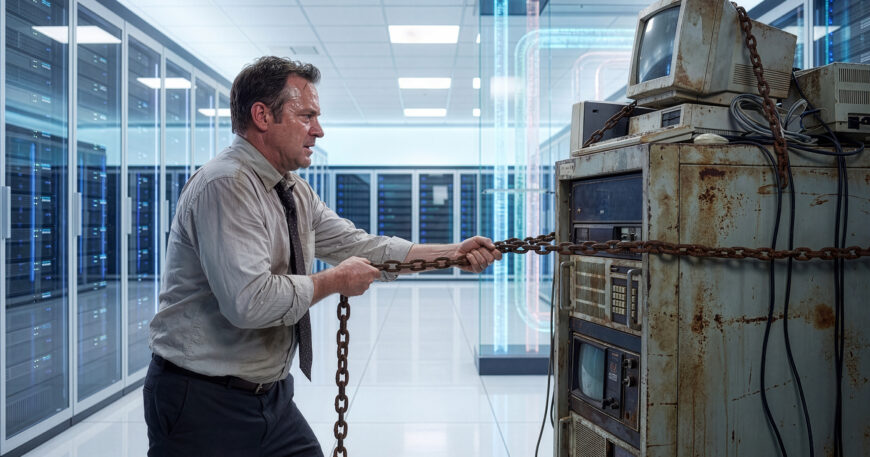
Modernization sounds simple until the system being replaced is the one keeping the organization running.
Across government, defense, critical infrastructure, and commercial environments, legacy systems often remain in operation because they still perform essential functions. They may support mission-critical applications, contain decades of organizational data, integrate with specialized hardware, or operate processes that cannot tolerate extended downtime.
The challenge is that the longer these systems remain in place, the more difficult they can become to secure, maintain, integrate, and support.
In 2025, the U.S. Government Accountability Office identified 11 federal legacy systems most in need of modernization. Eight relied on outdated programming languages, four included unsupported hardware or software, and seven were operating with known cybersecurity vulnerabilities. These systems support missions ranging from national security and critical infrastructure to health care and tax processing.
For organizations facing this challenge, modernization should not begin with the assumption that everything old must be replaced. It should begin with a more practical question:
How can we reduce risk, improve capability, and prepare for the future without disrupting the mission today?

Why Legacy Systems Remain
Legacy technology is easy to criticize from the outside. Inside an organization, the situation is usually more complicated.
A decades-old application may continue running because it performs its job reliably. A specialized system may rely on hardware or software that cannot easily be replaced. A customer may require an older platform because another critical system depends on it. Years of integrations, business processes, and institutional knowledge may have developed around the existing environment.
Replacing one component can therefore affect far more than that component alone.
A modernization project may involve migrating data, rewriting applications, changing network architecture, validating cybersecurity controls, replacing hardware, retraining employees, integrating cloud services, and testing every dependent system before the old environment can be retired.
Cost also plays a significant role. Modernization requires investment, while an existing system may appear less expensive because much of its infrastructure has already been paid for. Over time, however, the equation can change.
Maintenance becomes more difficult. Skilled personnel become harder to find. Replacement components disappear. Vendors end support. Security weaknesses accumulate.
What initially looked like the lower-cost option gradually becomes technical debt.
When Technical Debt Becomes Operational Risk
Technical debt is not inherently a failure. Every complex IT environment carries some of it.
The risk grows when organizations no longer have a clear understanding of what that debt is costing them.
Older systems may require manual processes that newer platforms could automate. Applications may depend on operating systems that no longer receive security updates. Specialized hardware may have few replacement parts available. Custom software may rely on programming languages understood by a shrinking number of employees.
GAO’s most recent examination of critical federal legacy systems illustrates the problem. Several of the systems it reviewed continue to use COBOL and assembly language, while others include obsolete hardware or vulnerabilities that cannot be fully remediated without modernization. GAO warned that incomplete modernization planning increases the likelihood of schedule delays, cost overruns, and project failure while prolonging dependence on increasingly vulnerable systems.
There is also a less visible risk: organizational knowledge.
In some environments, the most critical component may be the employee who understands why a system behaves the way it does. Years of undocumented fixes, custom configurations, dependencies, and workarounds can become institutional knowledge held by only a few people.
When those individuals retire, leave the organization, or move into different roles, the organization can lose knowledge that is difficult to recreate.
Modernization therefore involves more than technology lifecycle management. It also requires documentation, knowledge transfer, and a clear understanding of how systems actually support the mission.
Security Changes Faster Than Legacy Technology
One of the strongest arguments for modernization is cybersecurity.
A system designed ten or twenty years ago was created for a very different technology environment. Remote access was different. Cloud computing was less common or nonexistent. Identity management was less sophisticated. Cyber threats were different in scale, frequency, and capability.
Older environments may lack native support for modern authentication, encryption, centralized logging, endpoint security, microsegmentation, automated monitoring, or Zero Trust principles.
Organizations can compensate for many of these limitations. Firewalls, segmentation, identity controls, monitoring tools, and other safeguards can reduce exposure and extend the useful life of older platforms.
But compensating controls come with their own complexity.
Eventually, organizations must ask whether maintaining the old platform is creating more operational and cybersecurity risk than transitioning away from it.
Modern security strategies recognize that this transition will rarely happen all at once. NIST describes Zero Trust adoption as a gradual process rather than a wholesale replacement of existing infrastructure. Its guidance acknowledges that organizations will often operate hybrid environments where modern security architectures coexist with legacy systems for extended periods.
That reality makes modernization planning even more important.
Modernization Does Not Always Mean Replacement
A modernization program should begin with the mission, not with a particular technology.
For one organization, modernization may mean replacing an application entirely. For another, it may mean moving the application onto modern infrastructure while preserving its underlying functionality.
An organization might virtualize an older workload, modernize the network surrounding it, migrate selected services to the cloud, improve identity and access management, expose legacy functionality through modern APIs, automate manual processes, or gradually refactor an application over time.
In some cases, the right answer may even be to retain a legacy system temporarily while strengthening the environment around it.
NIST’s recent Zero Trust implementation guidance reinforces this incremental approach. Organizations are encouraged to begin by understanding their existing assets, security capabilities, data, services, and dependencies, then build modernization milestones based on risk and mission priorities.
That approach allows modernization to become manageable.
Instead of asking, “How do we replace everything?”, organizations can ask which changes provide the greatest improvement in security, reliability, supportability, and mission capability.
Modernizing Without Breaking the Mission
One of the greatest risks in any modernization effort is changing a system without fully understanding what depends on it.
Before migration begins, organizations need visibility.
Which applications communicate with each other? Where does critical data reside? Which users require access? What network pathways are necessary? What authentication systems are involved? Which processes depend on specific hardware or software versions?
Those questions may sound basic, but legacy environments often evolve over many years. Systems get added. Temporary solutions become permanent. Employees change roles. Vendors come and go. Documentation does not always keep pace.
A successful modernization effort therefore begins with discovery and assessment.
NIST specifically recommends inventorying existing hardware, software, applications, data, services, security capabilities, and other enterprise resources as organizations prepare for gradual modernization and Zero Trust adoption.
Once the environment is understood, modernization can proceed in phases.
A lower-risk system may provide an opportunity to validate a migration strategy before moving a mission-critical workload. New security controls can be introduced gradually. Data can be tested before final migration. Dependencies can be validated. Legacy systems can remain available during transition periods until the new environment has proven reliable.
This approach reduces the likelihood that modernization itself becomes a source of disruption.
The Hybrid Environment Is Here to Stay
For many organizations, modernization will not lead to a completely cloud-based environment or an infrastructure composed entirely of new systems.
The future will be hybrid.
Some workloads will run in commercial or government cloud environments. Others will remain in enterprise data centers. Specialized systems may continue operating on-premises because of mission, latency, regulatory, security, or technical requirements. Legacy applications may coexist with modern platforms while organizations gradually migrate functionality.
NIST recognizes this reality in its Zero Trust guidance, noting that significant enterprises are unlikely to complete these transitions within a single technology refresh cycle. Hybrid architectures may exist for an extended period as organizations modernize individual workflows and business processes.
That makes interoperability increasingly important.
Modernization should create an environment where new and existing systems can operate securely together while the organization steadily reduces unnecessary technical debt.
Architecture matters. So do networking, cybersecurity, systems administration, software development, data management, and operational support.
EOA Technologies brings these disciplines together through capabilities that include enterprise IT architecture, data center management, systems and network engineering, systems administration, cybersecurity, software development, and related infrastructure services.
Modernization often touches several of those areas at the same time.
Modernization Is An Ongoing Process
One of the biggest mistakes organizations can make is treating modernization as a one-time project.
Today’s modern system will eventually become tomorrow’s legacy system.
Technology changes. Vendors end support. Threats evolve. Mission requirements shift. New capabilities emerge. The long-term objective should therefore be creating an environment that can continue evolving without requiring another massive transformation every decade.
That requires lifecycle planning.
Organizations should know when major platforms reach end of support. They should understand where critical technical dependencies exist. They should document systems well enough that knowledge survives personnel changes. They should regularly evaluate whether infrastructure continues to meet security, performance, and mission requirements.
Modernization becomes far more manageable when these decisions are made continuously instead of waiting until aging systems force action.
Building Resilience for What Comes Next
The goal of modernization is not simply newer technology.
Modern systems can provide better visibility, stronger security, greater automation, improved scalability, simpler integration, and more efficient operations. They can make organizations more adaptable when requirements change and more resilient when disruptions occur.
That aligns closely with EOA’s broader mission of helping organizations accelerate digital transformation while strengthening cyber resilience.
The most successful modernization programs recognize that progress does not require abandoning everything that came before. They identify what still provides value, understand where risk has accumulated, and create a deliberate path toward a more secure and adaptable environment.
Modernization should strengthen the mission, not interrupt it.
The goal is not to replace everything old. It is to ensure yesterday’s technology does not prevent tomorrow’s mission.
References
Government Accountability Office, Information Technology: Agencies Need to Plan for Modernizing Critical Decades-Old Legacy Systems, GAO-25-107795, July 2025.
National Institute of Standards and Technology, Zero Trust Architecture, NIST Special Publication 800-207.
National Institute of Standards and Technology, Implementing a Zero Trust Architecture, NIST Special Publication 1800-35, June 2025.
National Cybersecurity Center of Excellence, Zero Trust Journey Takeaways.